- Log in
-
- Sydney Overseas Office
- London Overseas Office
- Toronto Overseas Office
- New York Overseas Office
- Ulaanbaatar Overseas Office
- Dubai Overseas Office
- New Delhi Overseas Office
- Manila Overseas Office
- Jakarta Overseas Office
- Hanoi Overseas Office
- Kuala Lumpur Overseas Office
- Singapore Overseas Office
- Bangkok Overseas Office
- Map
- Sydney Overseas Office
- London Overseas Office
- Toronto Overseas Office
- New York Overseas Office
- Ulaanbaatar Overseas Office
- Dubai Overseas Office
- New Delhi Overseas Office
- Manila Overseas Office
- Jakarta Overseas Office
- Hanoi Overseas Office
- Kuala Lumpur Overseas Office
- Singapore Overseas Office
- Bangkok Overseas Office
- HOME
- Plan Your Trip
- Transportation
- Subway
-
-
-
Subway
-
15
39
-
-
train_station
train
travel_by_rail
subway
train_travel
-
-
-
Subway
In any city, the subway is a useful means of transportation for travelers. There is no need to experience traffic jams and the subway lines are color-coded, making it easy to navigate. In Korea today, the metropolitan area including Seoul, Gyeonggi-do, and Incheon as well as Busan, Daegu, Gwangju, and Daejeon operate subways. Seoul subway not only operates throughout the city but is also connected to other regions such as Incheon, Gyeonggi-do, Gangwon State, and Chungcheongnam-do. When transferring to or from a bus with a transportation card, like the Tmoney card, you can receive a discount on your transfers so make sure to take advantage of it.
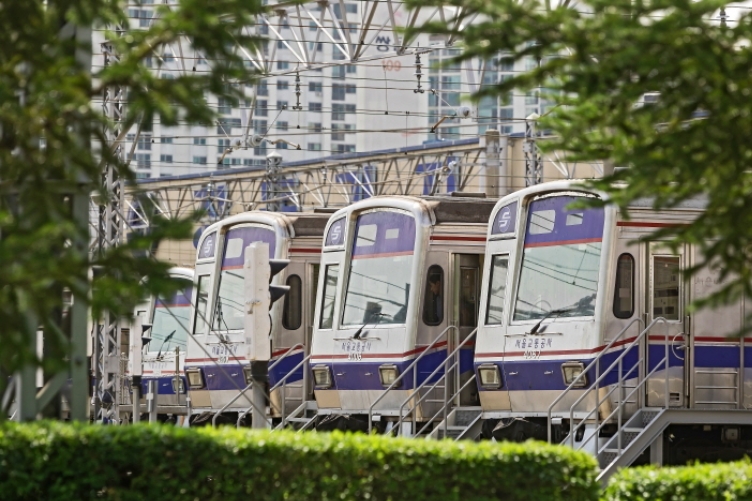 Seoul subway (Credit: Seoul Metro)
Basic guide
Seoul, Incheon, Busan, and Daegu operate multiple lines, while Daejeon and Gwangju have one line each. In cities with multiple lines, each line has its own color, so the lines can be distinguished by their names and colors. After you board a subway train, you can transfer between lines as many times as you like without passing through a turnstile again; however, an additional fee may apply depending on the distance traveled or whether you use certain lines, such as the Sinbundang Line or GTX. At transfer stations, different lines are connected through transfer passages, allowing passengers to move between lines conveniently. If you have a transportation card, such as a Tmoney card, you can enter the subway system simply by tapping your card at a turnstile. Even if you do not own a transportation card, you can purchase a single-use ticket at a ticket machine in the station, but the fare is typically more expensive than using a transportation card.
Metropolitan Area Subway (Seoul Subway)- Seoul Metro website: www.seoulmetro.co.kr (Korean, English, Chinese, Japanese)
- See Seoul subway map
Make sure to check out the Seoul Metro website
The site helpfully introduces everything from themed tour attractions to detailed subway usage guides in English, Chinese, and Japanese. Also, the FAQ section is great to prepare for any unexpected emergency situations.
* In case of an emergency, contact the station authorities by using an emergency phone installed on all subway station platforms or call the Seoul Metro customer center at +82-1577-1234.Busan Subway- Busan Transportation Corporation website: www.humetro.busan.kr (Korean, English, Chinese, Japanese)
- See Busan subway map
Busan subway stations offer one- or three-day tickets that allow unlimited rides within the specified period so take advantage of it!
For more detailed information, refer to the Busan subway fare guide. (Korean, English, Japanese, Chinese)
Daegu Subway- Daegu Transportation Corporation website: www.dtro.or.kr (Korean, English, Chinese, Japanese)
- See Daegu subway map
Daejeon Subway- Daejeon Transportation Corporation website: www.djtc.kr (Korean, English, Chinese, Japanese)
- See Daejeon subway map
Gwangju Subway- Gwangju Transportation Corporation website: www.grtc.co.kr
- See Gwangju subway map
Tip 1. Purchase a single-use transportation card and receive your deposit backSingle-use subway cards can be purchased at a ticket vending machine for an additional 500 won as a deposit. Afterwards, return the card at a deposit refund machine to get the deposit back. Simply insert the card in a deposit refund machine at the destination to get the refund.
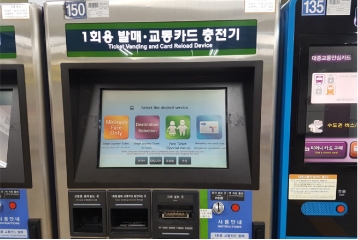 Tip 2. How to use a locker
Lockers for storing your belongings are installed at most subway stations. Fees vary depending on the size—small, medium, and large—and the storage time may also vary according to the terms of use for each facility. You can pay with a bank card or a transportation card and certain lockers can also be paid with cash. Most lockers also offer instructions in multiple languages.
Travelers in Seoul can also benefit from the T-Luggage service available in Seoul subway stations. It offers luggage storage as well as carrier services, assisting with the movement of your belongings within the station, between stations, and even from and to Incheon International Station, all on the same day—allowing you to enjoy your time without having to carry your luggage around. T-Luggage is available in major Seoul subway stations such as Seoul Station, Hongik Univ. Station, Myeong-dong Station, and Gimpo Int’l Airport Station. TIP 3. South Korea is well known around the world for offering free Wi-Fi, even on its subway
trains. With reliable Wi-Fi access underground, passengers can conveniently look up travel information or watch videos while on the move.
- How to use public Wi-Fi: www.wififree.kr (Korean, English)
✔️ Take advantage of foreigner-exclusive transportation cards—click here for details!* This page was last updated on October 8, 2026, and therefore the information may differ from what is presented here.
* 1330 Korea Travel Hotline: +82-2-1330 (Korean, English, Japanese, Chinese, Russian, Vietnamese, Thai, Malay)


Start a FREE Online Call
(No charges for calls on Wi-Fi /
Data charges may apply)

Open 1330 Helpline Chat(Download not required)