- Log in
-
- Sydney Overseas Office
- London Overseas Office
- Toronto Overseas Office
- Los Angeles Overseas Office
- New York Overseas Office
- Ulaanbaatar Overseas Office
- Dubai Overseas Office
- New Delhi Overseas Office
- Manila Overseas Office
- Jakarta Overseas Office
- Hanoi Overseas Office
- Kuala Lumpur Overseas Office
- Singapore Overseas Office
- Bangkok Overseas Office
- Map
- Sydney Overseas Office
- London Overseas Office
- Toronto Overseas Office
- Los Angeles Overseas Office
- New York Overseas Office
- Ulaanbaatar Overseas Office
- Dubai Overseas Office
- New Delhi Overseas Office
- Manila Overseas Office
- Jakarta Overseas Office
- Hanoi Overseas Office
- Kuala Lumpur Overseas Office
- Singapore Overseas Office
- Bangkok Overseas Office
Travelogues
-
-
-
[Hamyang, The Old House of Ildu in Hamyang]Gotaek Maru: Feel the warmth and history of South Korea at Ildu Historic House in Gaepyeong
-
03/27/2019
1.1K
-
0
0
-
-
-
-

Korea Travel Qrator
Georgia Jenist Scott
: United States

Korea Travel Qrator
Georgia Jenist Scott
: United States
Gotaek Maru :
Feel the warmth
and history of
South Korea
at Ildu Historic House
in GaepyeongNovember 24-26, 2018
#KoreaTourism #Mr Sunshine #hanok #gotaek #Gaepyeong #Hamyang #Hwarimgyegok Valley #Korean Culture #Korean scholars #Donghojeong Pavillion
* Korea Travel Qrator : A travel expert who explores Korea Quality-certified facilities and conveys the feeling of travel through vivid experience contents.
01Mr. Sunshine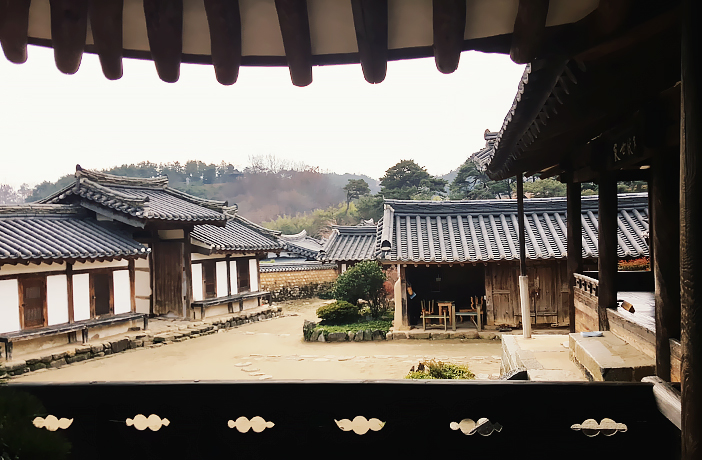
Beyond the eaves and decorative sides of the maru from the Sarangchae, the servants’ quarters and the main gate are off to the left.
It’s impossible to watch Mr. Sunshine without getting all the way immersed in the compelling range of emotions and conflicts from scene to scene as the drama unfolds. The magic of the deeply memorable, 24-episode historical Korean drama doesn’t lie simply in the actors (who are all outstanding), or the nearly 27,000-square-meter sets built in Nonson and Daejeon (which are lavish and unprecedented), or even in the powerhouse collaboration of the writer and director (which to the surprise of no one, was dynamic). The real magic comes from the perfectly maintained hanok buildings and natural landscapes that feature prominently in each episode.
Hanok are traditional Korean homes, and the first episode of Mr. Sunshine introduces us to the sprawling hanok of the show’s wealthiest landowners. First is the home of the cold-hearted Kim Pan-seo (played by Kim Eung-soo). As we watch the germinating moments of his plan to gift away young Choi Yoo-jin’s mother, the elegant, moonlit maru (similar to a porch or veranda), spacious madang (courtyard) and tile-roofed hanok provide a belying beauty and grace to the nefarious plot that drives the main storyline.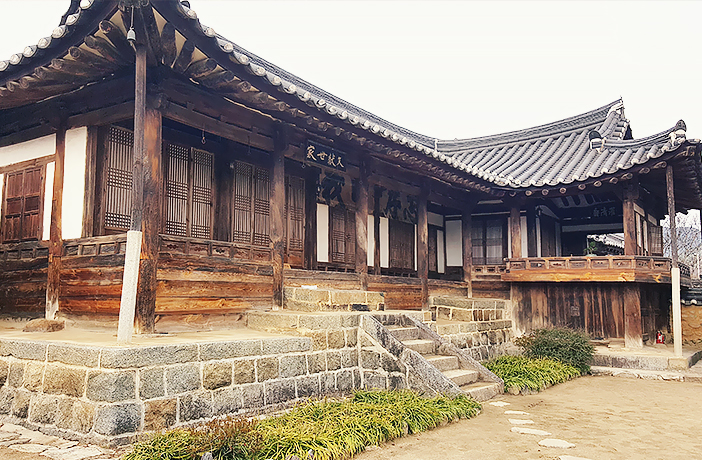
The main residence, known as Sarangchae. In the tv show, Mr Sunshine,
this is where Go Ae-shin’s grandfather lived.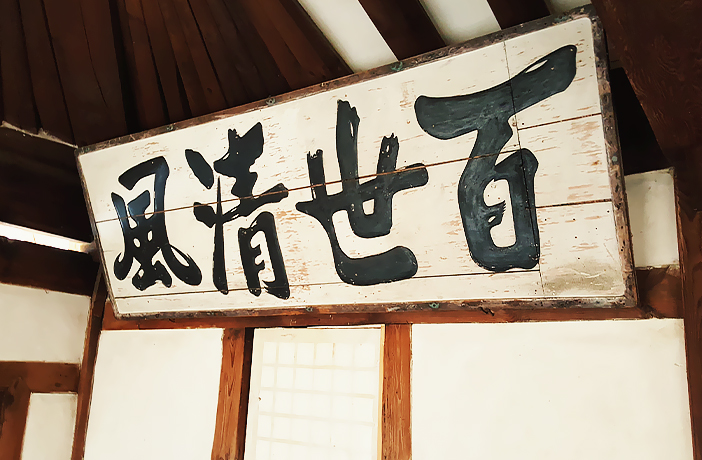
Inside the reading room of Sarangchae hangs a centuries-old Chinese calligraphy wishing good fortune to generations of Jeong Yeo-Chang’s descendants.
The second hanok we see is the august home of Go Sa-hong, played by Lee Ho-jae. The strong-willed scholar, former teacher of the king and grandfather of the show’s heroine, Go Ae-shin—played by Kim Tae-ri—stands under the eaves at the top of stone steps, as rain pours down and two of his son’s friends hold his dead son’s remains. The restraint he shows in the face of so much heartache is explained in the magnitude of his hanok estate. While not as fancy as Kim Pan-seo’s, Go Sa-hong’s hanok is large, with a towering wood gate at the entrance, a spacious madang, and a perfectly manicured Korean pine. Behind him is a large hand-painted sign in Chinese calligraphy that signifies his role as a scholar and the respect he commands in Joseon.
The hanok is not a set. It is the real-life home of Jeong Wie Kyoon, descendant of the scholar Jeong Yeo-Chang, who died in 1504. Considered one of the five top scholars of Joseon, he was posthumously given the name Munheongong by the king. The king! Already the parallels between the real-life hanok and Mr. Sunshine are remarkable. And while most hanok houses in Korea were built in the mid- to late 1900s, this has existed for so long that it is known as a gotaek, or historic house. For a hanok to be called a gotaek, it has to be at least 300 years old. This one is. Built around 1570, it existed decades before the Taj Mahal—home to generations of Jeong family members long before Shakespeare wrote Hamlet, Galileo identified the moons of Jupiter, Peter the Great became czar of Russia and the USA was even a British colony.Koreans say that staying in a gotaek is a completely different experience than just staying in an ordinary hanok – which in itself is pretty special. When pressed for more details, no one could explain. It was just a feeling they got. That same, inarticulate feeling is what makes the presence of a gotaek so magical in Mr. Sunshine. So how does one understand what can’t be put into words?
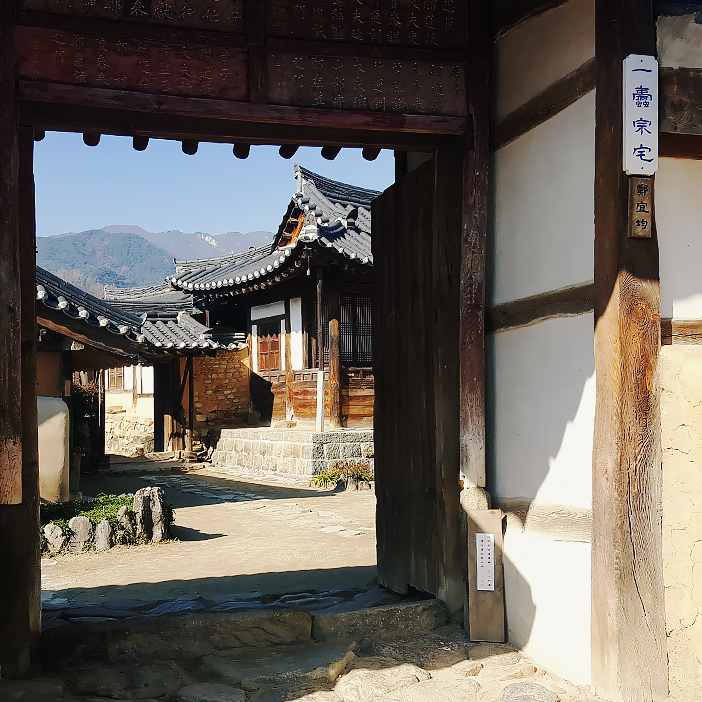
Looking into Ildu Historic House
02DonghojeongIf you have a car, fill up the gas tank.
On the outskirts of Gaepyeong, at the base of a small section of the Jirisan mountain range, is Hwarim-dong Valley. A scenic spot near the river has a small grouping of restaurants and cafes. The river itself is clean and winding, with rocks as big as boulders. A walking bridge behind the restaurants leads to a hiking path through the mountain.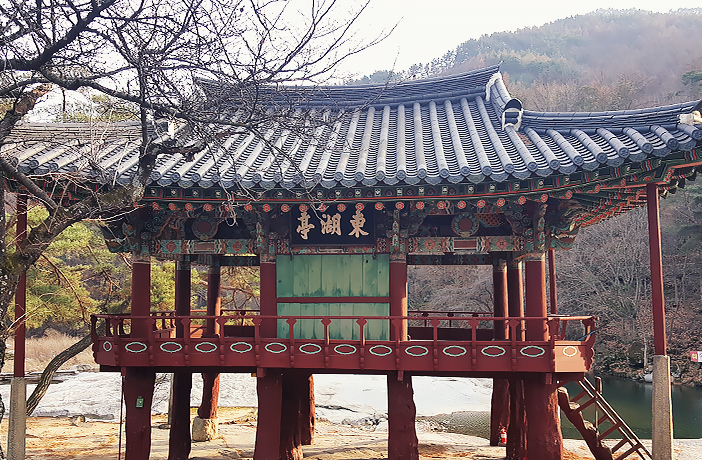
Donghojeong is a late 19th-century pavilion in Hwarimgyegok Valley.
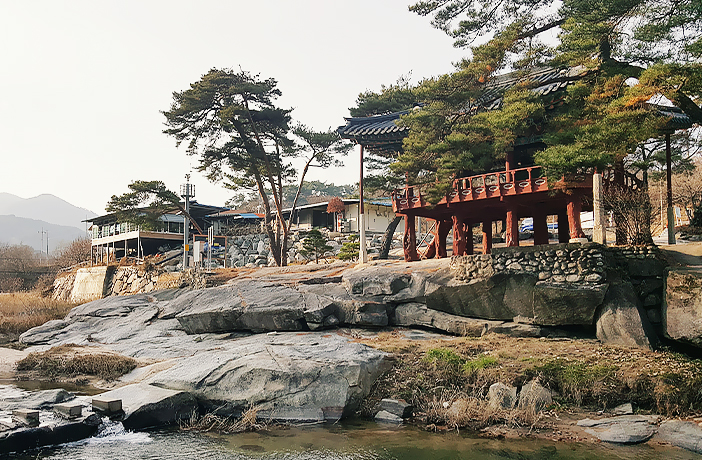
A view of Donghojeong Pavilion from the river
Off of Route 26, on the other side of the mountain, four historic pavilions are spaced out along the river bank. The largest is Donghojeong Pavilion. It has a step ladder carved out of logs, brightly painted beams, carved dragon heads, and paintings of daily life. Built in 1895, it was dedicated to a scholar who helped King Seonjo escape the Japanese invasion in 1592.
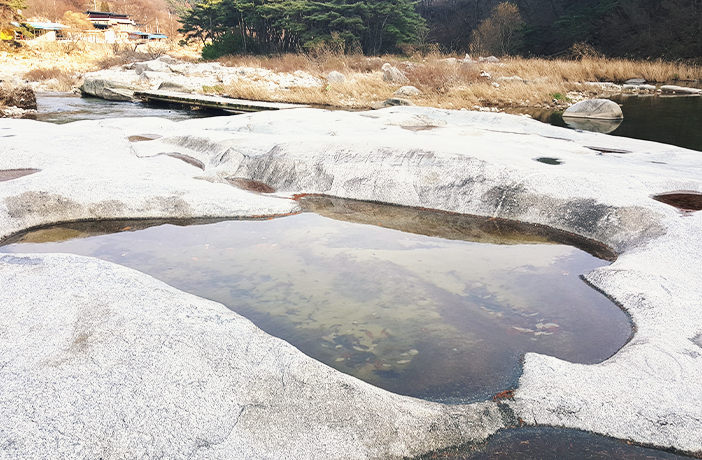
This massive rock is filled with rain water now, but according to lore, villagers used to fill it up with alcohol and drink from it while listening to performers.
In front of Donghojeong Pavilion, stepping stones lead to a rocky riverbed called chairam, the exposed part of which is big enough to fit 100 people. Lore tells of how villagers used to fill a crater in one of the rocks with alcohol, and drink out of it as singers performed on the yeonggadae, a large rock that doubles as a stage, and musicians played on geumjeogam, another rock stage just behind yeonggadae.
Every hanok has a maru. Before I went to Ildu Historic House, I thought it was just a porch. But I now know it is a place to gather. To be with family and friends. In Mr Sunshine, some events happened in a bar, some on a mountain, and some – indeed, many – happened on the maru of historical hanok. Today in Korea, we can still see the word maru. Like Chicken Maru or Hof Maru, meaning a warm place to gather with your family and friends for chicken or drinks. Learning that and so many other things has changed my understanding of Korean history and how that history remains connected to the land, people and everyday living.03Traveler's Room :
The Old House of Ildu in Hamyang
(함양일두고택)I decided to book a room. Not connected with an online booking service, the Jeong’s have their own website (http://www.ildugotaek.kr/). The site itself is only in Korean, but the automatic translator on some web browsers does a pretty decent job. To book my reservation, I used a translation app and we set up everything via text messages.
The property is called Ildu Gotaek, meaning the historic house of Il-du, Jeong Yeo-Chang’s nickname. My adventure there is a blur of very special, random moments and insights that highlighted many of the nuances in Mr. Sunshine and gave me an unexpectedly rich clarity about countless aspects of Korean culture, history, and people.
Ildu Historic House is in the rural hanok village of Gaepyeong, about a ten minute, 10,000 won taxi ride from the bus terminal in the town of Hamyeong. The closest big(ish) city with a train station and a movie theater is Jinju, about 30-minutes south by car. In Seoul, direct buses leave from Nambu Bus Terminal and Dong Seoul Bus Terminal, and in Daegu, they leave from Seobu Bus Terminal.
First stop: Hamyang
Hamyang is famous for green onions, dried persimmons, and stunning mountain and forest hikes. When you get there, stay for a while. As a segue to the laidback lifestyle of the hanok village, it’s quiet and easy to navigate. Most of the streets are only two lanes. The few that are wider use the extra lanes for street parking. Single family homes and duplexes outnumber apartment complexes, and only a spattering of buildings are taller than two stories. The independently-owned cafes and restaurants are small but their food and service help them outshine the glitz of a lot of chains.
Il-Du Historic House
You know the doyaega, or potter, Hwang Eun-san in Mr. Sunshine? Played by Kim Kap-su, he was fiercely loyal, strongly connected to the land, dedicated to his craft, and always approachable to the people around him. He reminds me a lot of Jeong Wie Kyoon, a soft-spoken family man who seems to have proudly embraced the weight of the responsibility of maintaining his 448-year-old ancestral home, as well as generously stepping aside as busloads of strangers stroll through the property.
In Gaepyeong, the Jeong family name looms large. The ancestral patriarch, Jeong Wang Chang was famously exiled as the leader of an unyielding faction of scholars. (An idea of what that must have looked like is offered in Mr. Sunshine, when Go Sa-hong led dozens of scholars to protest the king opening up Joseon to Japan.) The full extent of the modern-day Jeong’s property contains nearly a dozen buildings and gardens, known as dwimadang, most within the confines of Il-du Gotek’s main gate, and some across the cobblestone road. One of Mr. Jeong’s younger sisters owns the bibimbap restaurant at the entrance to Gaepyeong, and his niece owns the modern, hanok-style café across the street from Il-du Gotek.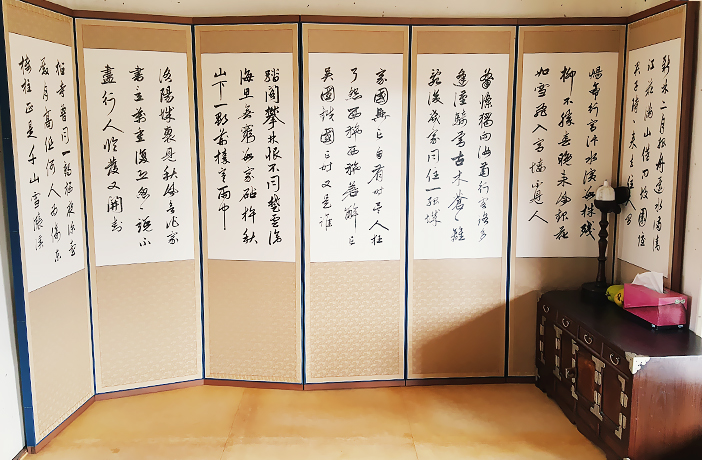
This screen with seven panels of poetry scrolls has been in the Jeong family for centuries. In the tv show, Mr. Sunshine, it features prominently in background when Go Ae-shin gets scolded by her grandfather.
It was surreal at first, and a little overwhelming, trying to place the scenes from Mr. Sunshine with the different buildings right in front of me. Each building has a name. At the main entrance, on the other side of the towering wood gate, is Hanchae, the servant’s quarters. In Mr. Sunshine, you can see it behind the maid and male servant, played by Lee Jung-eun and Shin Jung-keun, when they’re crying in the rain over the death of Ae-shin’s father—Go Sa-hong’s son.
Straight ahead is Sarangchae, Go Sa-hong’s residence and the main house of Ildu Historic House. The exterior is prominent in that first rainy scene. The interior is featured in episode two, when Ae-shin is scolded by her grandfather for reading newspapers. To the right, behind the pine tree, is Ahn. In Mr. Sunshine, this was Ae-shin’s residence. We can see how large it is when her cousin, Go Ae-soon, ransacks it looking for jewels to pawn.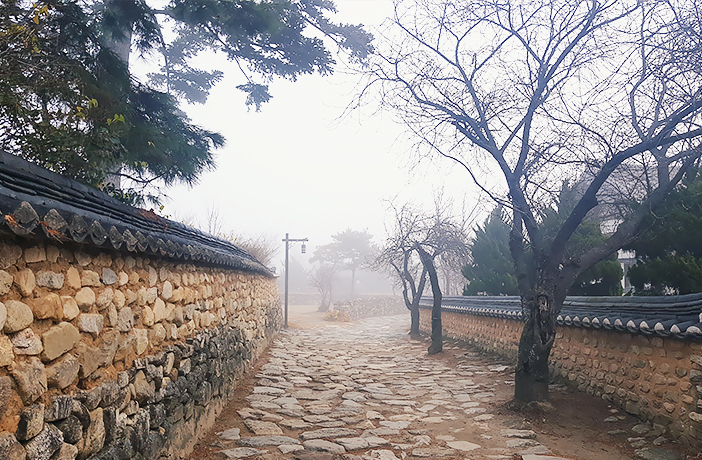
A cobblestone road separates Il-Du gotaek from the home that Jeong Wie-kyoon,
who currently owns the sprawling estate.Behind Sarangchae, accessible through the back bedroom and two paths on either side of Sarangchae, is another madang with three more buildings as well as a stone well similar to the one in Mr. Sunshine. One of the buildings is known as Anchae. This is where I stayed. At a cost of 100,000 won per night, I was giddy. From the outside, my room looked amazing. But in reality, most of it was boxed off for storage, so that the actual space wasn’t much more than a few square meters. The walls were lined with white construction paper riddled with tape-torn gray patches. It had three locked wooden chests of different sizes, two water bottles, two folded towels, two mogwa (quince) fruits, a can of bug spray, and a stack of folded bedding to make a palette when I was ready to sleep. It was cold, both from a lack of heat and a lack of character. It was nothing like the bright living spaces on Mr. Sunshine. I had barely stepped through the threshold before I turned around saying over and over, “No, no this isn’t right.” I kept thinking that I’d paid 100,000 won for an empty shell. No bathroom, no tv, no place to sit, no room to breathe.
Then I remembered what everyone said. Staying in a historic house is a special experience. I decided to take a deep breath, stop thinking about what I didn’t have and start concentrating on what was there. Over the next 18 hours, in the morning fog, midday sunshine, and quiet nights, I had delicious food, coffee, delicacies and beer reminiscent of scenes in Mr. Sunshine, and engaged with immeasurably friendly people. During the day, I walked among the tourists and observed what caught their attention. At night it was just me, alone in the entire compound. I looked high at the curved clay tiles, low at the sparse, swept courtyards, and far away at the mountains in the distance. I followed the curves of the mortared stone walls, and looked closely at the centuries-old foundation. Everything used to construct each building, gate and well was natural: wood, soil and rock, and assembled in accordance with Confucian techniques. The beams are solid pine, the windows slide or fold up like flaps.
The doors swing on carved out pivots, the brass locks are works of art, and the foundations are elevated in order to allow air to flow and keep moisture from building up. The underfloor heating system, called ondol, is a series of tunnels and vents fed from an agungi, or furnace—sizable arches in the foundation of the house or at the bottom of the kitchen stove. When the buildings are in use, cats like to cozy up near the warmest parts. At other times, the arched entrances are covered with loose tiles. Those tiles are also handy for propping open doors, and funneling rain water off the roof.That paper on the walls and windows is actually pretty expensive hanji, traditional Korean paper. It absorbs moisture during Korea’s humid summers, and releases it when the air is dry. The mogwa fruit in my room was picked on their land, and Koreans sometimes use it as a fragrant, natural diffuser.
Sightseeing
Any visit to Ildu Historic House should include a walk around Gaepyeong, which is partially bordered by a peaceful stream, and has at least four properties listed on the national heritage registry, as well as dozens of other hanok and gotaek houses. Each one is different, and exploring the entire village reveals how much hanok are built to suit the available space and the owner.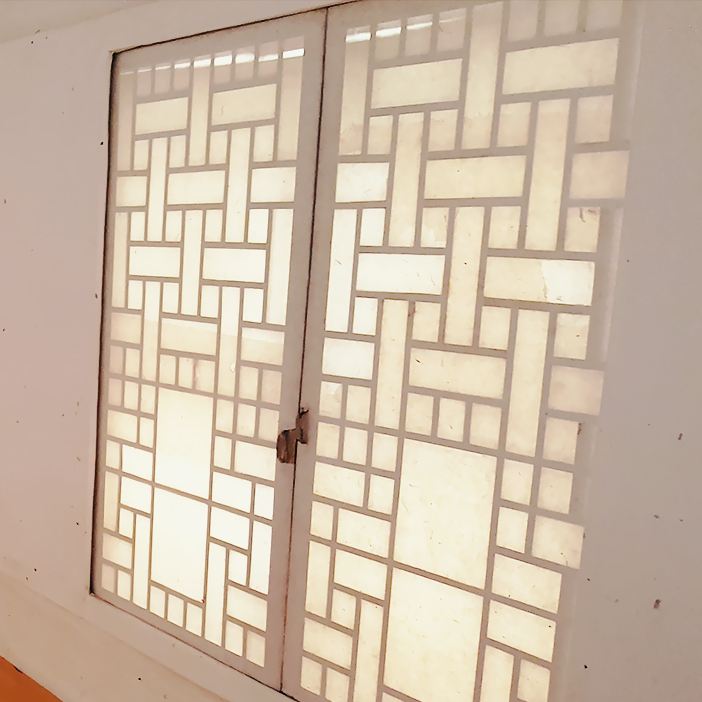
Hanji is traditional Korean paper to absorb moisture.
Hotel InformationHotel Information - Hotel name, Website, Address, Price, Tel, Check in/out Hotel name The Old House of Ildu in Hamyang Website www.ildugotaek.kr Address 50-13, Gaepyeong-gil, Jigok-myeon, Hamyang-gun, Gyeongsangnam-do Price 50,000 won ~ 400,000 won Tel +82) 10-6395-5111 Check in/out 2 PM / 11 AM Korea Travel Qrator's TipYou have to remember that Ildu Historic House is not a hotel. It is a landmark hanok. So it doesn’t have modern amenities. Also, the bathroom is outside of the room you sleep in. For instance, the bathroom was 31 steps away from my room. On warm nights, that’s not so bad, but on cold or rainy nights, it can be uncomfortable. Also, the owner is amazing. He speaks limited English and is completely reachable via text messages.
1. This column was last updated in December 2018, and therefore information may differ from what is presented here. We advise you to check details before visiting.
2. This travelogue is written by Travel Qrator Georgia Jenist Scott, all contents are opinions based on my own experiences.


1330 Helpline Call/Chat

Start a FREE Online Call(No charges for calls on Wi-Fi /
Data charges may apply)

Open 1330 Helpline Chat(Download not required)