Fall in Korea is the season where one sees the most dramatic expression of nature’s colors. Red, yellow, and other brilliant seasonal colors bloom across the peninsula, joined by festivals and events that find their place among the cool breeze. Jeolla and Gyeongsang, two provinces that divide the peninsula’s southern portion, are especially known for events that combine the uniquely Korean aesthetics with contemporary cultural touches. We introduce to you some of the festivals that bring this tradition of communal festivity to today’s world.
Jeollanamdo Sanaji Festival
Art without boundaries, shaped by the fields, islands, and sea
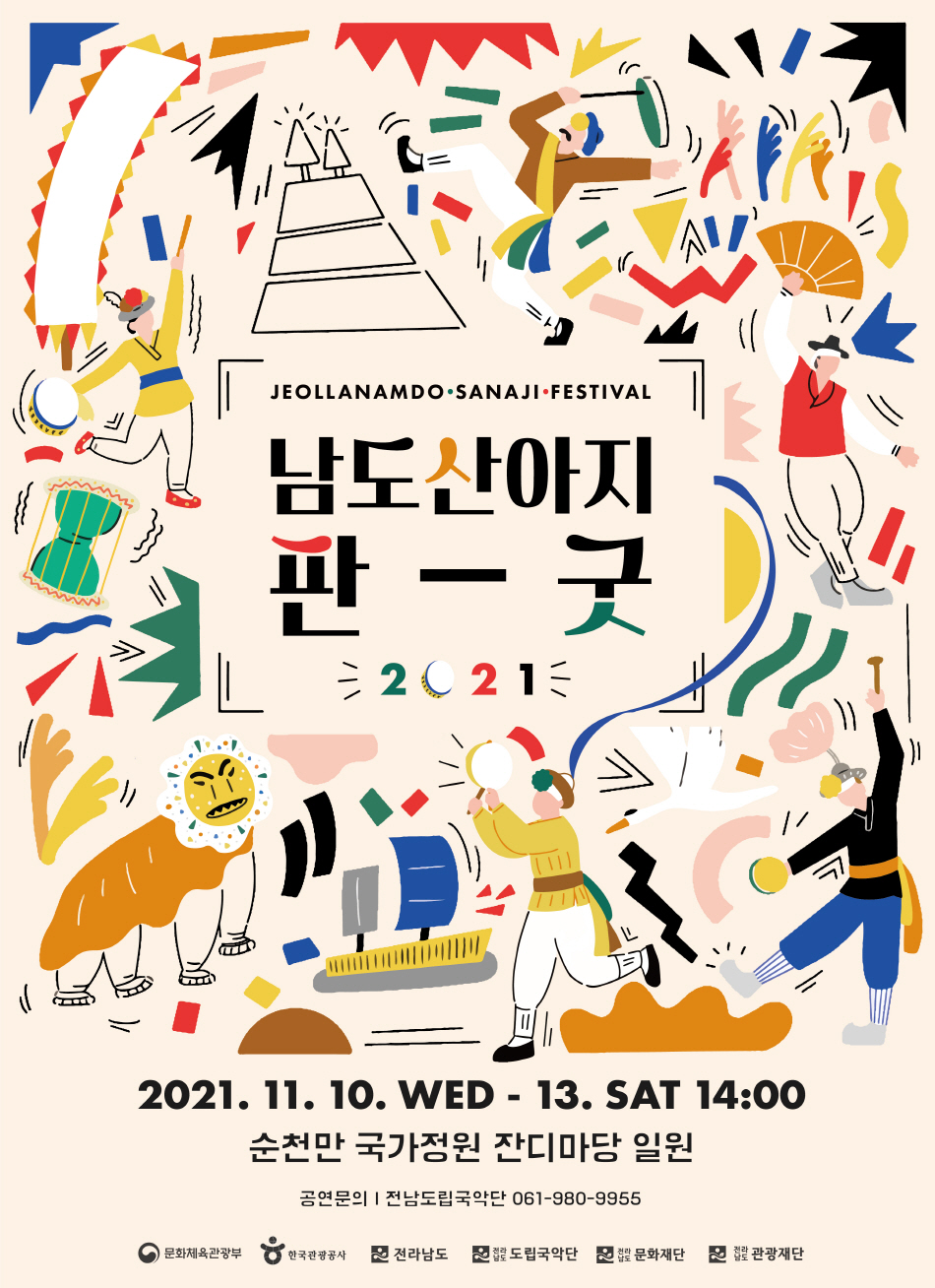
This festival is a contemporary reinterpretation of Jeollanam-do’s oral traditions, passed down in the region for more than 400 years, by the Jeonnam Provincial Gugak Company. It takes the form of pangut, an open-air performance combining namdo minyo (southern folk songs), pansori (epic chanting), and dancing that also involves songs, plays, and performances from the audience. The word “sanaji” here refers to the wish that young rice shoots would grow well and yield an abundant harvest.
The performance is made up of four parts. Starting with gil nori, a musical street parade leading to the main stage at the grass lawn, the first stage is composed of pungmul nori (farmers’ music) and a talchum mask dance. The second part is the festival’s main performance, including the seoljanggu concerto, a janggu (hourglass drum) performance with a gugak orchestra; Beompijungnyu, a song celebrating the view of the coast in the classical pansori work Simcheongga; and Jodo datbae norae, a song sung on an anchor boat. These stages are notable in that they utilize the elements of nature in their stage directions. The third and fourth parts are the participatory stage, which includes performances such as ganggang sullae (circle dance), a well-known folk game passed down in the coastal areas of Jeollanam-do; tightrope walking with music; and sangmo nori, a dance with a spinning-tassled hat. The performance ends with a unified stage where the audience members, musicians, and artists come together.
Suncheonman National Garden, this performance’s venue, is a great place to enjoy Korean nature, being made up of 11 world gardens and a lake garden and designed by world-renowned landscape designer Charles Jencks. Technology such as LED media walls, Jimmy Jib camera cranes, and drones are used to bring the videos of the performances to life, while surround sound systems and bridge videos relay each part’s story to the audience.
- Genre
- Musical
- Period
- 2021.11.10 (Wed.) – 11.13 (Sat.)
- Place
- Grass lawn in Suncheonman National Garden’s lake garden
- Age Limit
- AOpen to all
- Running Time
- 70 min
- Date & Time
- 14:00
Tools and Dance
Narrating technical artistry through street dance
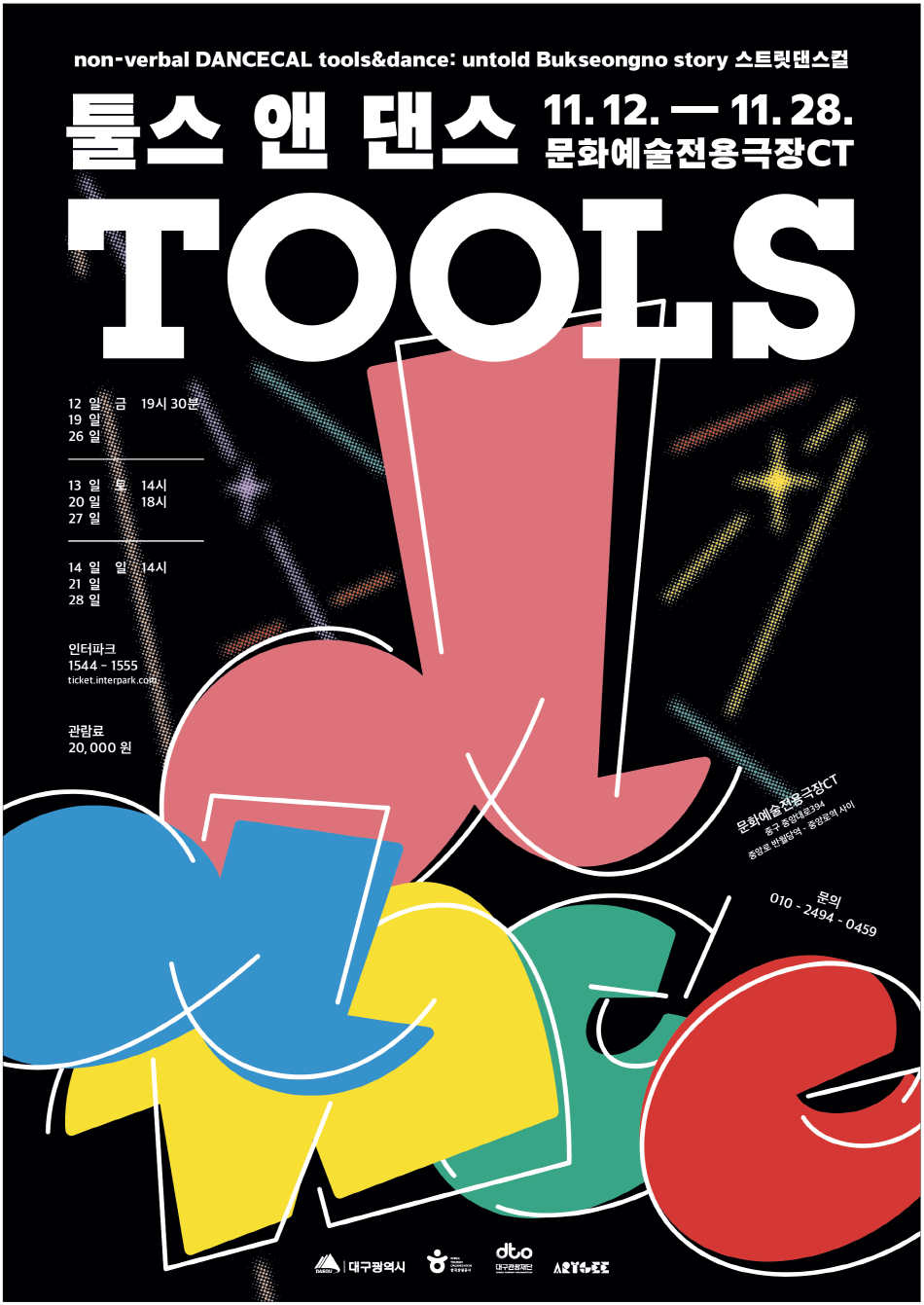
This performance reinterprets the story of Bukseongno district and the artisans living in the area through rocking, popping, break dancing, hip-hop, and krumping. Bukseongno is a district in Daegu that was historically home to many artisans, but industrialization quickly increased the neighborhood’s real estate value, attracting speculators and other unscrupulous types into the area. Tools and Dance is a work dedicated to the surviving Bukseongno artists, who, despite the rapidly changing world around them, continue to stoically hone their craft. The dancers’ goal is to narrate the story of technical artistry with the manifold facets of street dance tradition. The stage also makes use of graphic design, gaming lingo, and other visual design techniques to reinterpret the space of Bukseongno.
Mr. Park Gong-gu is a technician who has spent his entire life in Bukseongno, the gentrification of which leaves him and his fellow technicians with dwindling livelihood opportunities. Driven by economic desperation, he receives a project by scientist Cho Gyeong-je, who is trying to build a multipurpose construction robot. Unbeknownst to Mr. Park, the scientist is secretly an unscrupulous man who saddles technicians with impossible tasks, hoping to chase them away from the neighborhood with convenient “accidents.” Of course, Mr. Park is blissfully unaware of Cho’s plans. He returns to Bukseongno and calls up his neighbors, who are legendary technicians in their own right, to create a superteam of masters. Their mission is twofold: bring the project to a successful conclusion, and recreate Bukseongno’s halcyon days. Can the team build the robot successfully?
Each technician is imbued with distinct styles and dance genres that speak to their strengths. The project is a collaboration between street dance team ARTGEE, with their nimble cheerfulness and comical attitude, and mime artists, media artists, and independent filmmakers.
- Genre
- Musical
- Period
- 2021.11.12 (Fri.) – 11.28 (Sun.)
- Place
- Daegu Culture and Arts Theater CT
- Subtitles Provided
- English
- Age Limit
- Open to all
- Running Time
- 100 min
- Date & Time
- Friday 19:00; Saturday 14:00, 18:00; Sunday 14:00; 12 performances in total
- Inquiries
- Interpark
Mongyeon - Flower of Seodong
A pansori dance musical with traditional Korean dance
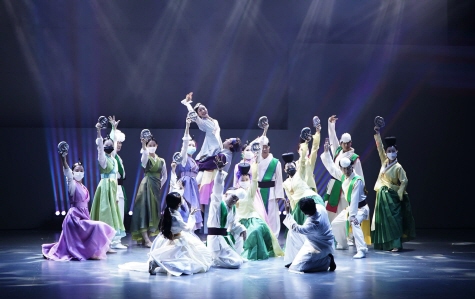
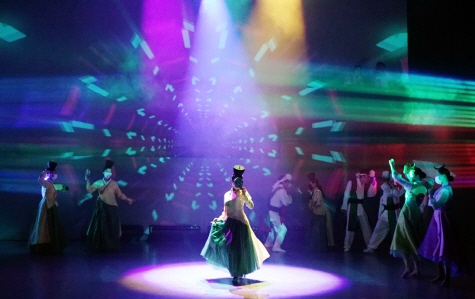
This dance musical combines the pansori (epic chant) tradition of Korea with traditional dance, contemporary music, and digital stage technologies. It is based on Seodongyo, a folk song detailing the myth of Seodong of Baekje and Princess Seonhwa of Silla in Korea’s Three Kingdoms Period 1,500 years ago. Through the reinterpretation of their story, the musical animates the dream of Baekje’s revival, love, and the harmony between Korea’s Gyeongsang and Jeolla provinces.
The Kingdom of Baekje suffers a decisive military defeat in their campaign to take the Han River basin, and finds itself in a precarious situation against its rivals, the Kingdom of Goguryeo to the north and the Kingdom of Silla to the east. Baekje hopes for a chosen king to lead the Kingdom to glory, and Seodong, a prince, is born under the auspices of the golden dragon. Despite the difficult situation, Seodong grows up to be a resolute monarch. One day, the king sneaks into Sillan territory and falls in love at first sight with Princess Seonhwa. Determined to marry her, Seodong begins to spread a bizarre song among the people.
Compared to conventional musicals’ focus on songs and dialogue, this piece relies on dancing to drive the plot forward. The beautiful movement of traditional Korean dance in tune with pansori forms the core of this work, the highlight being the narration-in-dance detailing how Seodong’s rumors reach the king’s ears. The stage uses lighting to emphasize the dance, and has two side screens that offer English translations.
- Genre
- Musical
- Period
- 2021.07.23 (Fri.) – 12.04 (Sat.)
- Place
- Grand Theater, Jeonbuk Art Hall
- Subtitles Provided
- English
- Age Limit
- Above 7 years old
- Running Time
- 70 min
- Date & Time
- Wednesday, Thursday 19:30; Friday, Saturday 15:00
- Inquiries
- Naver, Ticketlink