- Log in
-
- Sydney Overseas Office
- London Overseas Office
- Toronto Overseas Office
- Los Angeles Overseas Office
- New York Overseas Office
- Ulaanbaatar Overseas Office
- Dubai Overseas Office
- New Delhi Overseas Office
- Manila Overseas Office
- Jakarta Overseas Office
- Hanoi Overseas Office
- Kuala Lumpur Overseas Office
- Singapore Overseas Office
- Bangkok Overseas Office
- Map
- Sydney Overseas Office
- London Overseas Office
- Toronto Overseas Office
- Los Angeles Overseas Office
- New York Overseas Office
- Ulaanbaatar Overseas Office
- Dubai Overseas Office
- New Delhi Overseas Office
- Manila Overseas Office
- Jakarta Overseas Office
- Hanoi Overseas Office
- Kuala Lumpur Overseas Office
- Singapore Overseas Office
- Bangkok Overseas Office
Contents View
- HOME
- Contents View
-
-
-
Artificial Joint Surgical Robot for Precision Surgery with Reduced Errors
-
11/18/2022
-
2.6K
0
0
-
-
Gyeonggi-do
Suwon
Orthopedics
Korea_Medical_Tourism
Recommended_Hospitals
-
-
-
Lee Chun Tek Orthopedic Specialty Hospital develops Korea's first artificial joint surgical robot, Dr. LCT
As the aging of the population accelerates globally, knee arthroplasty has become more common these days, and a growing number of these procedures are operated using robots. Currently, more than 70,000 patients in Korea undergo knee arthroplasty every year, and about 10% of the cases are robot-assisted. In 2002, Lee Chun Tek Orthopedic Specialty Hospital located in Suwon, South Korea introduced ROBODOC -- an artificial joint surgical robot, a first in Korea. In 2021, the hospital succeeded in developing Dr. LCT, the first artificial joint surgical robot in Korea. Developed with clinical data from 16,000 surgical cases, Dr. LCT reflects the needs of surgeons and patients.

Currently, for Korean nationals, robot-assisted knee arthroplasty is covered by national health insurance, except for the cost of disposable consumables necessary for robot-assisted surgery (e.g., bone cutters). There is not much difference in the cost among Korean patients due to national health insurance coverage for domestic patients. However, the costs may vary significantly for overseas patients depending on the required examinations. Foreigners who wish to receive robot-assisted knee arthroplasty can obtain accurate information by contacting the International Healthcare Center of Lee Chun Tek Orthopedic Specialty Hospital (1588-2927) or the Gyeonggi International Medical Association (031-222-4783).
When Is Arthroplasty Needed?
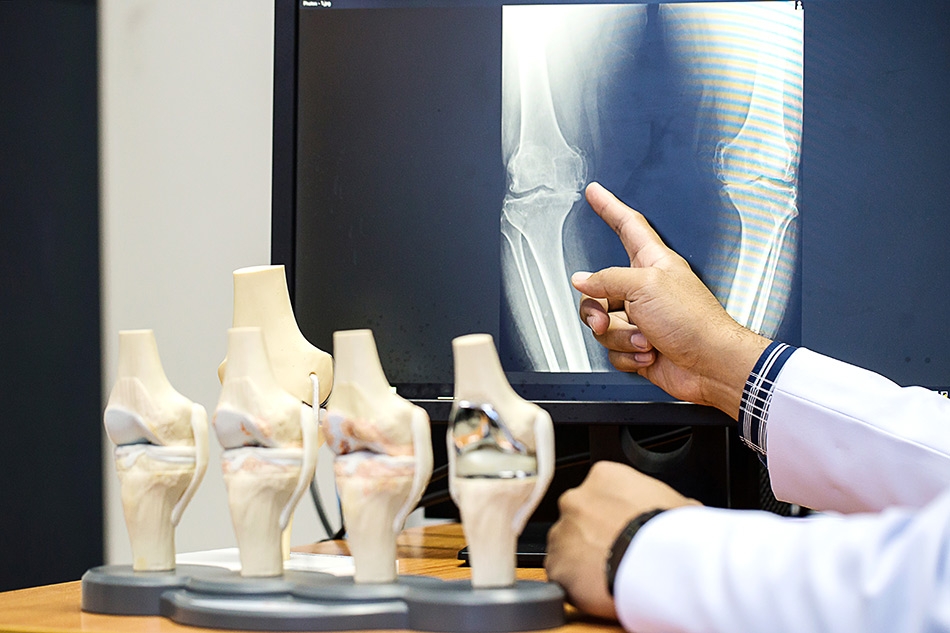
Arthroplasty is surgery that inserts an artificial joint into patients who suffer pain and deformation as the cartilage between their joints is worn out due to degenerative changes, etc., mainly degenerative arthritis. The main purpose of the operation is to relieve pain and restore the joint's function. Damaged cartilage cannot be restored naturally, so up to now, arthroplasty is the only proven surgical method for end-stage degenerative arthritis.
What's the Difference Between Manual and Robot-assisted Surgery?

The biggest advantage of robot-assisted surgery is accuracy and consistency. The degree and angle of cutting the bone are planned based on CT scan images before surgery. Meanwhile, manual surgery relies on the experience and sense of the surgeon. Of course, manual surgery will have good results if an experienced and skilled surgeon performs it. However, the consistency of the outcome cannot be guaranteed. Meanwhile, robot-assisted surgery offers customized operations based on accurate data while minimizing inconsistency in surgical results.
The success of arthroplasty lies in inserting the artificial joint at an accurate angle to ensure lower limb alignment in the neutral position. Robot-assisted surgery can consistently cut the bone at the desired angle and insert an artificial joint to achieve neutral knee alignment, resulting in excellent results. Currently, robots for artificial joints are mainly used for knee arthroplasty.
In 2019, Lee Chun Tek Orthopedic Specialty Hospital disclosed their robot-assisted knee arthroplasty data obtained for the past ten years at the globally renowned American Academy of Orthopedic Surgeons (AAOS). The hospital observed 300 patients who received robot-assisted knee arthroplasty ten years ago versus a control group of 300 patients who received manual knee arthroplasty in the same time period. The hospital compared the pain score (quantified improvement of knee pain) and function score (quantified improvement of motor skills). Those who received robot-assisted knee arthroplasty scored 89 points in the pain score, 5 points higher than the control group (84 points). As to the function score, patients who underwent robot-assisted knee arthroplasty recorded 91 points, 9 points higher than the control group of 82 points.Over 20 Years of Dedication in Developing Dr. LCT
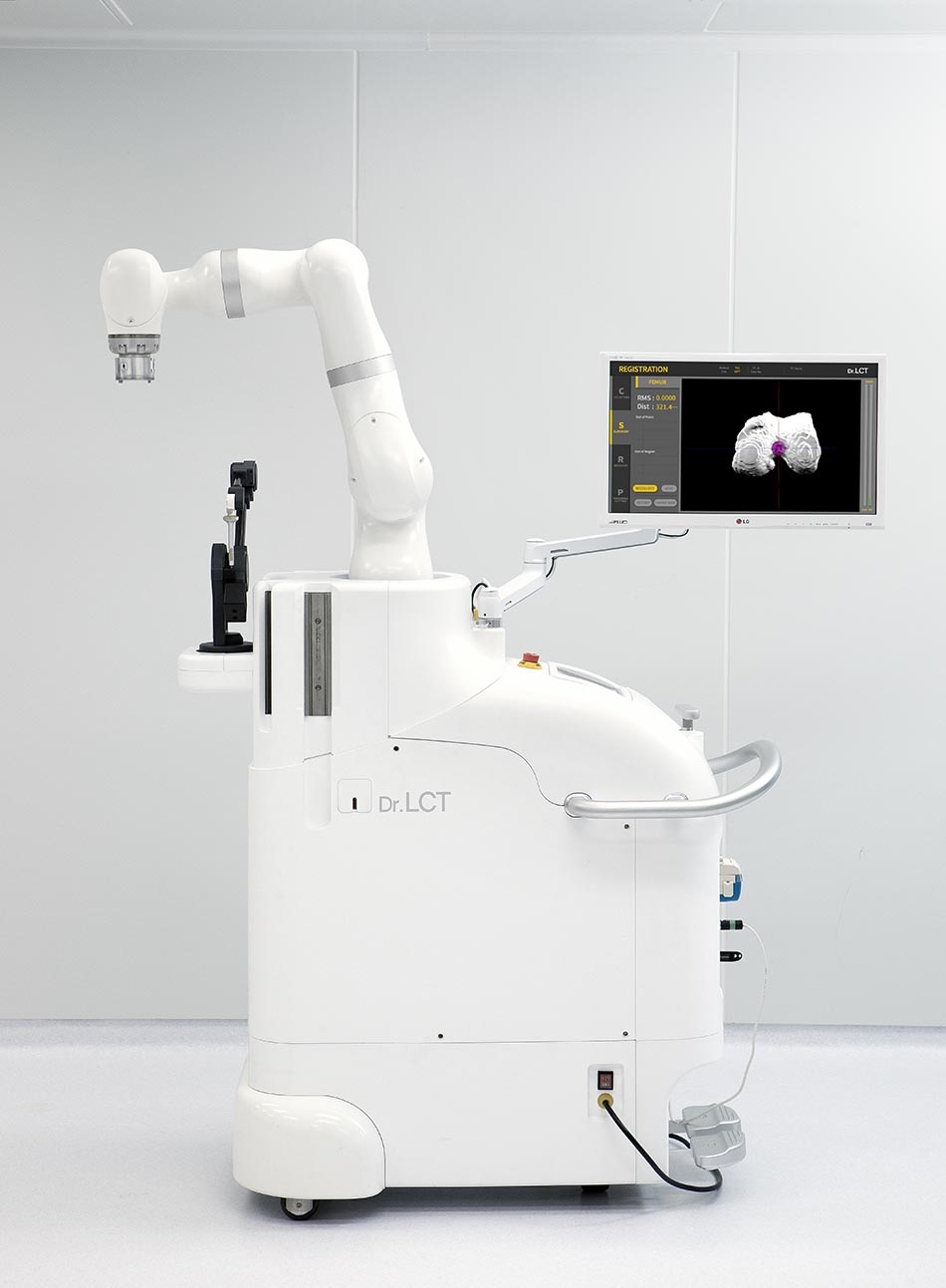
The efforts of Lee Chun Tek Orthopedic Specialty Hospital to develop an artificial joint surgical robot date back about 20 years. The late Director Chun-tek Lee first saw an artificial joint surgical robot at an international conference and introduced ROBODOC for the first time to Korea in October 2002, believing that such surgical robots would become a leading medical technology in the future. The surgical results were satisfactory in the early phase, but the surgical process was not. The process of preparing and performing the operation was very complicated, causing inconveniences to surgeons. Plus, the robot-assisted operation took a long time. Many hospitals that introduced Robodoc in its early phase failed to overcome such inconveniences and gave up robot-assisted surgery.
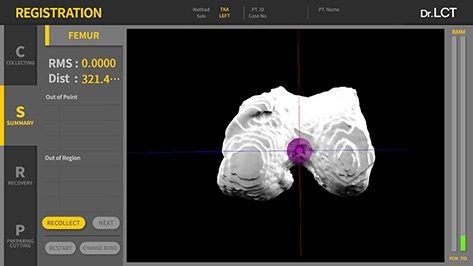
However, Lee Chun Tek Orthopedic Specialty Hospital opened the Robot-assisted Arthroplasty Research Center in 2005 to actively overcome these difficulties. They developed a new cutting system and combined it with minimally invasive surgery (MIS) to minimize soft tissue damage, thus reducing the recovery period and improving patient satisfaction. Also, the center developed a registration system. Registration is the procedure of matching the pre-operative plan information with the patient’s actual surgical site. In other words, it gives the robot information about the bone's location. It is an important process because it directly affects the precision of robot-assisted bone cutting. Thanks to the newly developed registration system, the average registration time was reduced from 17 minutes to around 3 minutes. The margin of error was reduced as well, allowing more precise results. As such, the hospital's continued R&D efforts to upgrade Robodoc satisfied both patients and doctors. Dr. LCT is the outcome of ceaseless effort by the research center’s best robot experts and computer programmers.Combination of Over 16,000 Clinical Results
From the planning and development stage, the research center thoroughly reflected surgeons' needs when developing Dr. LCT through close communication with them. In addition, the center also combined experience and know-how gained from approximately 16,000 cases of robot-assisted surgery. While Robodoc's arm is a 5-axis, Dr. LCT is a 7-axis, allowing more free and detailed movements. Dr. LCT can cut areas in a limited space that cannot be accessed using the 5-axis robotic arm, creating optimum conditions for MIS. Plus, surgeons can stably control the stronger robotic arm to cut necessary areas quickly. Furthermore, the robot can control the cutting speed in real-time depending on the hardness of the patient's bones, enabling an optimized operation for each patient. Dr. LCT also drastically reduces the operation time by removing unnecessary movements in the surgical process.
The size of the robot was significantly reduced to one-third the size of existing robots. Unlike conventional robots that are divided into a body that cuts joints and a console (adjustment device), Dr. LCT is an all-in-one system. The robot is compact, so it can be conveniently moved. With fewer wires, the robot has lower risks of contaminating the operating room. Another merit is that the robot is fully automated. The robotic arm cuts the bone as planned and stops when an error occurs. This is what differentiates Dr. LCT from the conventional semi-automatic robots whereby a surgeon has to hold the robot's arm to cut the bones. In addition, other robots are supposed to use only a designated artificial joint product, but Dr. LCT was designed to use any artificial joints.What Are the Side Effects of Robot-Assisted Arthroplasty?
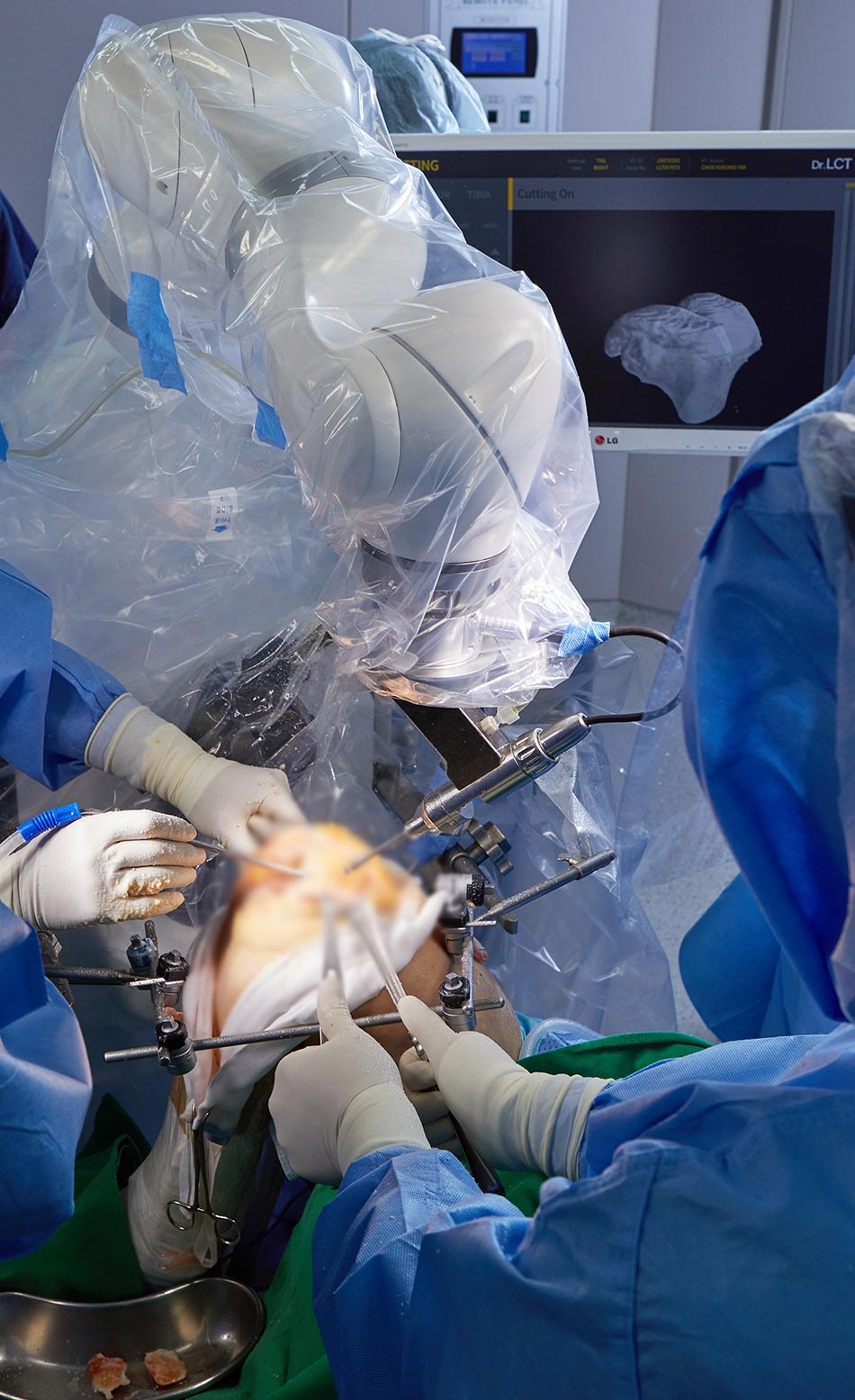
Basically, no surgery has zero side effects, but robot-assisted surgery has no particular side effects that are different from those of manual surgery. The rate of major and minor complications as a result of manual arthroplasty is around 3% to 5%, gradually decreasing with the development of surgical techniques. In the case of robot-assisted arthroplasty at Lee Chun Tek Orthopedic Specialty Hospital, the complication rate is less than 1%. With the introduction of Dr. LCT, the operation time has been reduced to less than 1 hour, and the adoption of MIS has reduced the incision size, shortening the recovery period. Patients can walk the next day after surgery. Rehabilitation treatment begins on the 5th day after surgery, and patient can be discharged after about 10 days of rehabilitation. Once discharged, they do not need to visit the hospital for rehabilitation as they can exercise at home. The patient will then need to visit the hospital every 3 to 12 months for regular checkups.
Robot-assisted Arthroplasty Process
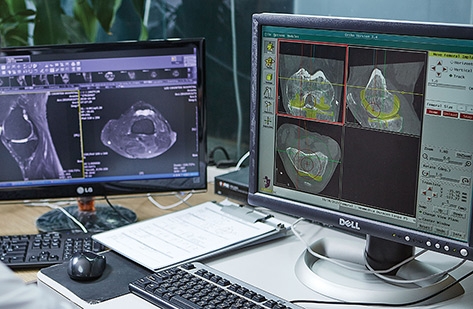
- STEP01 Perform a CT scan before surgery. The goal of step 1 is to develop accurate surgical plans because each patient has a different bone shape, size, and degree of deformation.
- STEP02 The optimum surgical plan for the patient is established by converting the CT image into a three-dimensional image.
- STEP03 Virtual surgery is performed before the actual surgery to confirm the location of where the bone is cut or to correct the angle.
- STEP04 After the registration process in the operating room, the bone is cut with the robotic arm, and an implant (artificial joint) is inserted.
Robot-assisted Knee Arthroplasty Success Case
- 1. 58-year-old Male
- Symptoms Suffered severe pain and swelling when walking. Had pain in the knee and it was hard for him to get up while seated. He received arthroscopic knee surgery 4 years ago.
- Diagnosis Method and Disease Degenerative arthritis on the left knee
- Treatment Robot-assisted knee arthroplasty on the left knee
- Result Current condition is good (improved motor function and relief from pain)
- 2. 82-year-old Woman
- Symptoms Both knees were sore and painful even when she was not moving, so it was impossible to perform daily activities. Severe pain interfered with sleeping.
- Diagnosis Method and Disease Degenerative arthritis on both knees
- Treatment Robot-assisted arthroplasty on both knees
- Result Current condition is good (improved motor function and relief from pain)
※ The above patient cases are from Lee Chun Tek Orthopedic Specialty Hospital (http://lct.co.kr/).
noteReviewed by Sung-hwan Yoon, Director of Lee Chun Tek Orthopdic Specialty Hospital
Written by Reporter Jung-yoon Kim


Start a FREE Online Call
(No charges for calls on Wi-Fi /
Data charges may apply)

Open 1330 Helpline Chat(Download not required)