
Current language
English
- Log in
-
- Sydney Overseas Office
- London Overseas Office
- Toronto Overseas Office
- Los Angeles Overseas Office
- New York Overseas Office
- Ulaanbaatar Overseas Office
- Dubai Overseas Office
- New Delhi Overseas Office
- Manila Overseas Office
- Jakarta Overseas Office
- Hanoi Overseas Office
- Kuala Lumpur Overseas Office
- Singapore Overseas Office
- Bangkok Overseas Office
- Map
Popular search
- Sydney Overseas Office
- London Overseas Office
- Toronto Overseas Office
- Los Angeles Overseas Office
- New York Overseas Office
- Ulaanbaatar Overseas Office
- Dubai Overseas Office
- New Delhi Overseas Office
- Manila Overseas Office
- Jakarta Overseas Office
- Hanoi Overseas Office
- Kuala Lumpur Overseas Office
- Singapore Overseas Office
- Bangkok Overseas Office
Wellness Story
-
-
-
Jewonhaneul Farm
-
11/17/2023
-
2.2K
0
0
-
-
-
-
Jewonhaneul Farm: My Private Healing Space, Courtesy of Fresh Tangerine Fields
Take a seat under a tangerine tree, meditate with a singing bowl, and partake in various food therapies using organic tangerines hand-picked by yourself. Jewonhaneul Farm is a healing farm where you can relax your body and mind just by walking along the tangerine-scented trails.
Jewonhaneul Farm
- Address: 72-5 Daeheulbuk-gil, Jocheon-eup, Jeju-si, Jeju-do
- Inquiries: +82-10-9601-1788
- Website: www.instagram.com/jewonhaneul/
Operating hours: 09:00-18:00 (open all year round); reservation is required for a program.
Fees: Singing bowl meditation KRW 10,000 / Food therapy (cookies) KRW 25,000 / Food therapy (cake) KRW 25,000 / Singing bowl meditation + food therapy (cookies or cakes) KRW 30,000 / Tangerine picking KRW 10,000 (1kg)

Jewonhaneul Farm is a tangerine farm with an open field of 28,000㎡ and an 8,300㎡-wide greenhouse. The farm received “non-pesticide,” “'GAP,” and “low-carbon” certifications from the Ministry of Agriculture, Food and Rural Affairs. In 2022, the farm rebuilt itself into a healing farm that combined singing bowl meditation and food therapy. The couple who owns the farm, Mr. Kang Seong-heup and Ms. Oh Sun-geum, gave their farm a pretty nickname, “Gyullang Garden.” “gyullang” is a Jeju dialect for tangerine tree.
Heal Your Body and Mind on the Fresh Tangerine Field
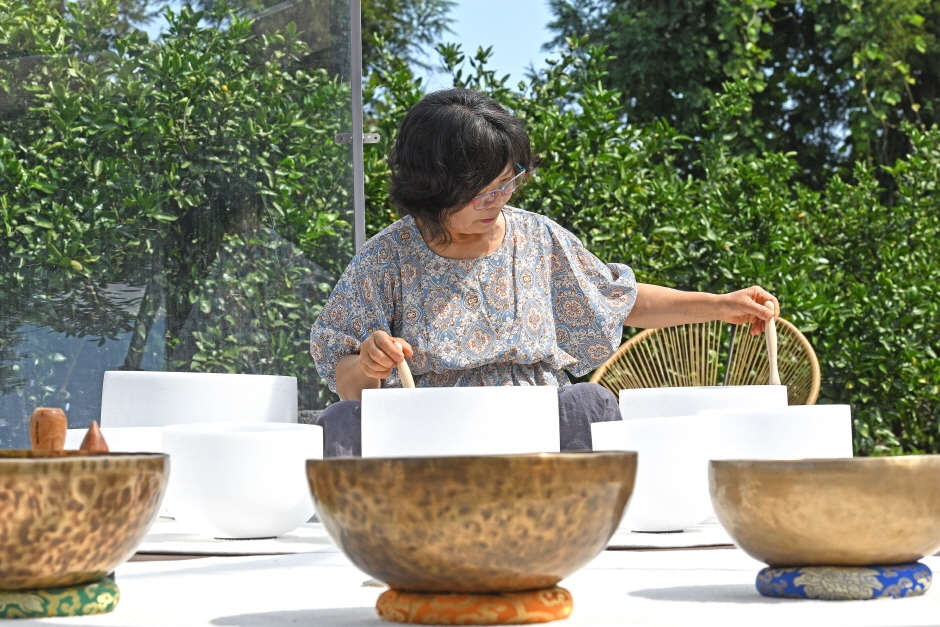
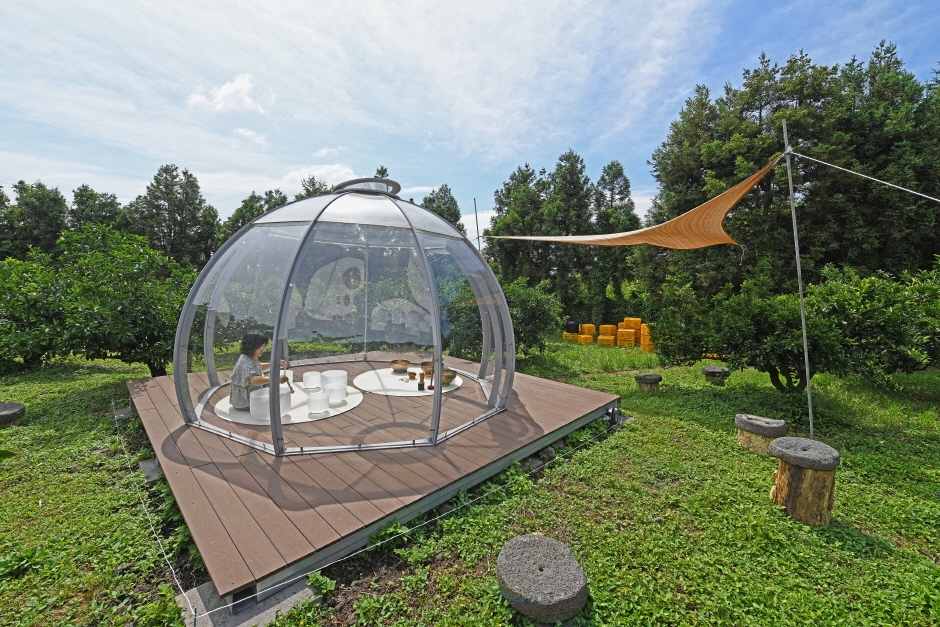
The signature wellness program of Jewonhaneul Farm is the singing bowl meditation. Walk along the trail from the farm entrance for about 10 minutes, and you will see a dome-shaped structure called Blobee, where singing bowl meditation is practiced. Blobee, a structure that serves as both a hotel rooftop and a glass greenhouse, is made entirely of transparent material; although it is an artificial structure, it exists in harmony with the surroundings.
Mr. Kang Seong-heup and Ms. Oh Sun-geum, chose “sound” as the theme of the healing farm because of the sounds of nature that always fill the farm. They liked how the chirping of the birds soothed their tired bodies. They were grateful for the sound of bugs comforting their worried minds. They wanted to share those moments of comfort with as many people as possible, so that they can experience the feeling like the one that children feel in their mother's arms. The singing bowl meditation was chosen as the signature program thanks to the deep and subtle resonance resembling the sound of nature.
The singing bowl is used by Tibetan monks for meditation. It makes sounds when tapped or rubbed with a stick. The faster you turn the stick on the rim of the ball, the louder it gets. Singing bowls are made of crystal or metal, and the sound of a metal singing bowl is lower and heavier than that of a crystal singing bowl. Since Jewonhaneul Farm uses both types of singing bowls, you can meditate while appreciating their differences. After an hour of meditation, you can try your hand in singing bowl playing yourself. Just tap and rub the bowl with a stick, and take the time to delve into the beauty of its sound. Only metal singing bowls are used for individual performance, as they are not easily broken. Oh Sun-geum even obtained a singing bowl practitioner certification to perform singing bowl meditation effectively.
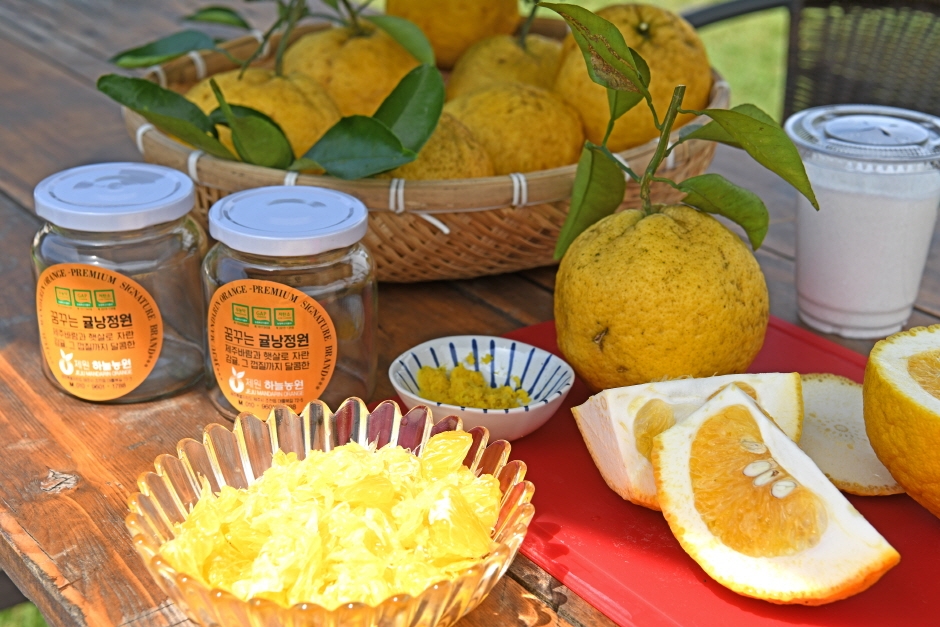
The main feature of food therapy at Jewonhaneul Farm is tangerines. Organically grown tangerines are great food on their own, but they are much richer in taste and nutrients when made into syrup or marmalade. The harvest time for tangerines varies slightly depending on the breed, but marmalade and syrup are made from tangerines harvested in the summer between July and August.
The Tangerine Bakery makes cookies and cakes, and is a suitable for children. Its cookies and cakes are made with candied tangerines instead of raw tangerines. Candied tangerines are a rare delicacy made by boiling tangerines cut in half with sugar and starch syrup for more than 3 hours. Jelly-like candied tangerines are like the icing on the cake that gives the finishing touch to the cookies and cakes.
Enjoying Beautiful Tangerine Fields All Year Round
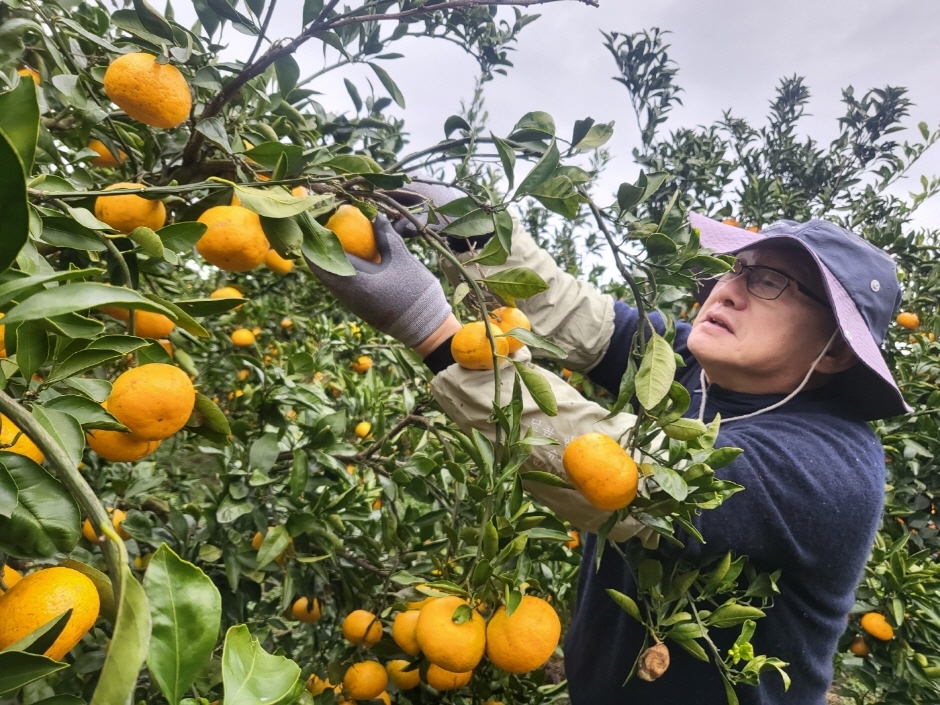
Tangerine picking is open from mid-October to December. When picking tangerines, the trick is to cut them while leaving about 1cm of the stalk. This will prevent injuries from the sharp scissors. Before putting tangerines in the box, tidy up the stalks once again. The trail in the tangerine fields of Jewonhaneul Farm is a space for healing in and of itself. The walking trail winding through the tangerine trees is attractive all year round, but its beauty shines from late April to early May when the tangerine flowers are in full bloom, and in November when the tangerines are ripening. Many people deliberately visit the farm in winter to enjoy the snowy scenery.
NOTE
Various Performing Arts Programs
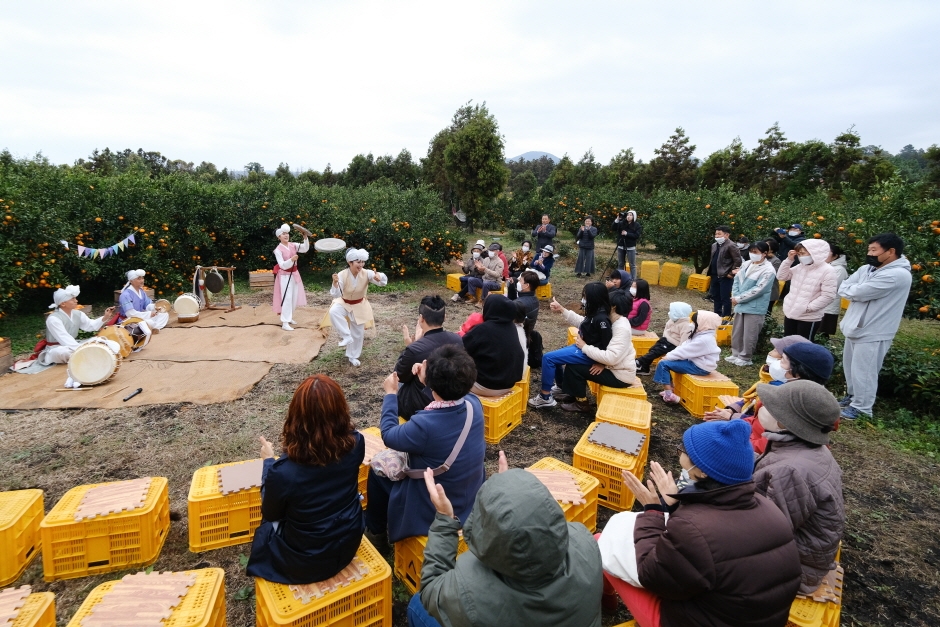
Jewonhaneul Farm organizes healing concerts four times a year. The healing concert features musicians of various musical instruments such as saxophone, ocarina, and trumpet, and comes with fun activities including tangerine juice and water kimchi making. The highlight of the healing concert is the Gyullimpungak performance held in autumn. The full schedule for the healing concert can be found on the social media page of Jewonhaneul Farm.
Nearby Places to Visit
Dodubong Peak
TDodubong Peak is the best viewpoint to watch airplanes take off and land at Jeju International Airport.
San 2, Doduil-dong, Jeju-si, Jeju-do
Biyangdo Island
Biyangdo Island, an island connected to Udo Island, is one of the top three backpacking spots in Korea.
146, Hallimaean-ro, Hallim-eup, Jeju-si, Jeju-do
Hagosudong Beach
Hagosudong Beach is the most popular beach in Udo Island. On this beach embracing Biyangdo Island, you can enjoy swimming and canoeing in the jade-colored sea.
Yeonpyeong-ri, Udo-myeon, Jeju-si, Jeju-do
Hansupul Haenyeo School
As Korea's first training center for haenyeo (female divers), Hansupul Haenyeo School offers maritime programs such as haenyeo experience and snorkeling activities.
623-6 Hallimhaean-ro, Hallim-eup, Jeju-si, Jeju-do
-
* Content creation & related inquiries:
Medical & Wellness Team

1330 Helpline Call/Chat

Start a FREE Online Call(No charges for calls on Wi-Fi /
Data charges may apply)

Open 1330 Helpline Chat(Download not required)


Open messenger app(Messenger app must be installed)

 Medical Wellness