Seoraksan Mountain, Korea’s most famous mountain, became the country’s fifth national park in 1970 and the first UNESCO Biosphere Reserve in 1982. Its rocky terrain, waterfalls, ponds, and lakes combine to create one of the best natural landscapes in Korea. Seoraksan Mountain, a famous Korean mountain praised by the American news network CNN and the subject of many Korean painters, is a perfect example of Korea’s elegant natural beauty.
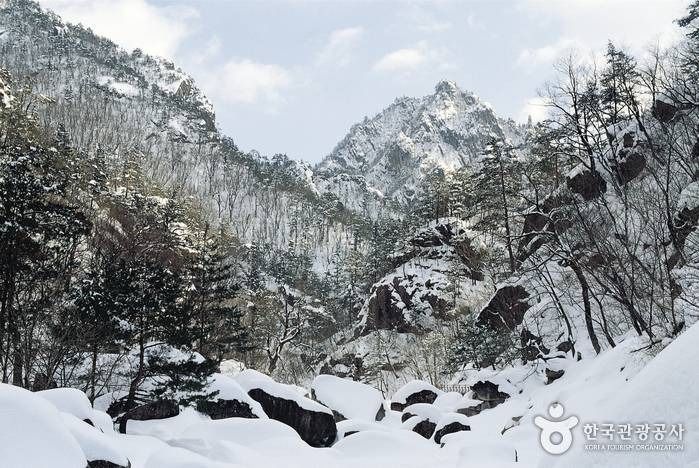
Trekking through some of Korea’s best scenery
Seoraksan National Park is a treasure trove of natural resources, covering a vast area of 398.237 ㎢ and home to many of the world’s rarest plants and animals. With three branching ridge systems centered on the highest peak, Daecheongbong Peak, the park is home to many natural attractions, such as Ulsanbawi Rock, Sibiseonnyeotang Potholes, and Biryongpokpo Falls, as well as famous temples such as Sinheungsa Temple and Baekdamsa Temple. There are various hiking trails with different difficulty levels and atmospheres, so you can choose according to your physical condition and preferences.
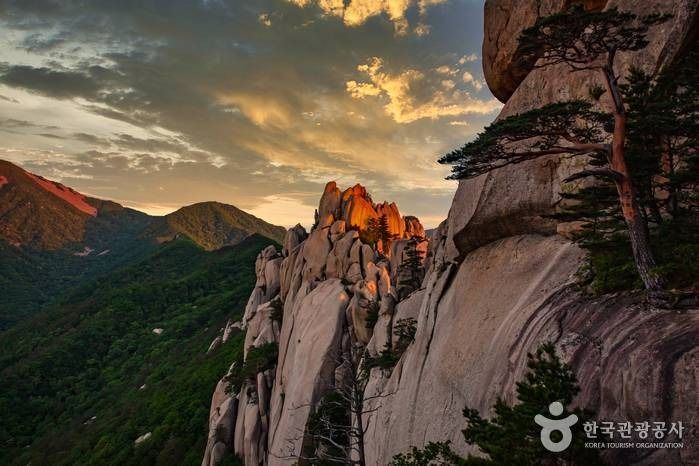
One of the most popular is the hike to Ulsanbawi Rock, a representative scenic resource of Seoraksan Mountain, which is 3.8 km long and takes about two hours each way. The Ulsanbawi Route starts at Seoraksan Small Park in Sokcho, a popular tourist destination in Korea. From the small park, you’ll pass by Sinheungsa Temple and Heundeulbawi Rock to reach Ulsanbawi Rock. Seoraksan’s specialty, Heundeulbawi Rock, is a round rock that stands precariously on a flat rock. It looks like the rock will roll over if you touch it, but even if one person or several people push it, it only wobbles (“heundeul“) and stays in place. Anyone passing by this route is curious to try pushing Heundeulbawi Rock once. The final destination of the route, Ulsanbawi Rock, is a majestic display of rock formations that will leave you speechless. This route is beautiful all year round, but it is at its best in the fall when the leaves change colors. Seoraksan Mountain has many other attractive trekking routes, including Yongsopokpo Route, Baekdamsa Route, and Daecheongbong Route. Moreover, there are many roots starting from Seoraksan Small Park in Sokcho, including the Ulsanbawi Route, Biryongpokpo Route, Geumganggul Route, Yangpok Route, and Gongnyong Ridge Route.
A mountain that inspires many people, including artists
Seoraksan Mountain’s beautiful scenery has captivated the hearts of artists as well as the general public and has been featured in many works of art. Biseondae Rock, a spectacular view of Seoraksan Mountain, was included in the Geumgangsaguncheop (Album of the Four Districts of Geumgang) presented to the king by the famous Joseon-era painter Kim Hongdo. One of BTS RM’s favorite artists, Kim Chong-hak, is also known as the “Painter of Seorak” for his paintings of the four seasons of Seoraksan Mountain. Devastated by divorce, Kim ChJong-hak abandoned everything and headed to Seoraksan Mountain in a state of despair to live there, but he gained strength from nature and began to paint nature in earnest. Thus, he became known as the “Painter of Seorak” by capturing the nature of Seoraksan Mountain for so long. Park Dae-sung was one of the favorite painters of Samsung’s late chairman, Lee Kun-hee, who had a deep knowledge of art and had the artist’s work in his office. He also stayed in Seoraksan Mountain for a long time and painted the rocky mountain. When Pope John Paul II visited South Korea in 1984, the South Korean president presented him with a landscape painting depicting Seoraksan Mountain.Seoraksan Mountain is a sacred place that has inspired dreams and inspiration for many people over the years. Um Hong-gil, the world’s first mountaineer to complete 16 peaks in the 8,000-m Himalayas, joined Seoraksan Mountain after graduating from high school and spent a year and a half climbing the mountain to improve his skills. In addition, Han Yong-un (pen name: Manhae), a famous Korean historical figure, lived in Baekdamsa Temple on Seoraksan Mountain and wrote masterpieces such as “The Silence of Love,” and Kim Si-seup, a Joseon Dynasty poet, created his masterpieces at the Oseam Hermitage on Seoraksan Mountain.
 Programs
1. Visitor Guide ProgramA program to learn about the natural ecology and culture of Seoraksan Mountain with a guide. Several programs are held throughout Seoraksan Mountain, but the programs available at Seoraksan Small Park include an explanatory program introducing Seoraksan National Park and a program to explore Biryongpokpo Falls.
 Address
(Seoraksan Small Park), 1055, Seoraksan-ro, Sokcho-si, Gangwon-do
 Inquiries
+82-33-801-0900

 Nearby tourist attractions
Kensington Hotel Seorak (President’s room, South-North Korean Summit venue, Beatles collection, etc.)
Sangdomun Stone Wall VillageSokchohaebyeon Beach, Sokcho Eye Ferris Wheel
Sono Felice Delpino The Ambrosia (Café with a view of Ulsanbawi Rock)
Sono Felice Delpino Infinity Pool
Goseong Neungpadae Tafonies (BTS filming location)Goseong Wanggok Village