goto content


Korea Banner (Left)


Gyeongsangbuk-do » Gyeongju-si » Gyeongju National Park (경주국립공원)

print

Gyeongju National Park (경주국립공원)   
Gyeongju National Pa...
prev  
  • Gyeongju National Pa...
  • Gyeongju National Park (경주국립공원)
  • Gyeongju National Park (경주국립공원)
  • Gyeongju National Park (경주국립공원)
  • Gyeongju National Park (경주국립공원)
  • Gyeongju National Park (경주국립공원)
next
view pictures
Address
Nodong-dong, Gyeongju-si, Gyeongsangbuk-do
경북 경주시 노동동 경주시 일원
Type
20 National Parks
Inquiries
• 1330 tt call center: +82-54-1330 (English, Korean, Japanese, Chinese)
• For more info: +82-54-741-7612~4, +82-54-741-7612~4, +82-54-741-7612~4, +82-54-774-7615 (Korean)
Homepage
www.gyeongju.knps.or.kr (English, Korean, Japanese, Chinese)
Introduction
Gyeongju National Park is a bevy of cultural preserves dating back to the Silla Dynasty.

Unlike the other parks located in the area, this park is segmented into individual districts. However, admission fee covers entry to the entire park because the districts are segmented for the government administration. Because Gyeongju itself is a historic city with many important historic sites and relics, Gyeongju is divided into 7 districts, and the park is divided accordingly.

The Namsan area of Gyeongju is called the Namsan District. This is where many stone Buddhist statues, stone pagodas and about 100 temples sites are found. Here you can find Poseokjeong Pavillion, which was part of the living quarters the king had prepared outside of the palace for feasts. The Namsan District contains many relics spread about the area. You might feel like you took a ride on a time machine to a Buddhist temple of the past.

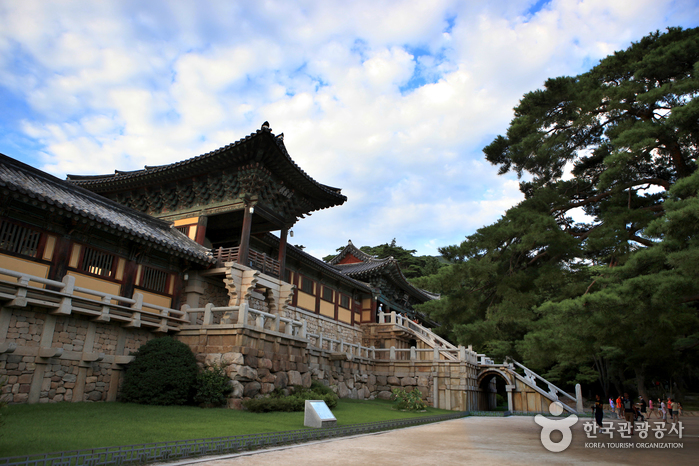
Another district is the Mt. Tohamsan District. Here you will find the most famous tourist sites of Gyeongju, Bulguksa Temple. Bulguksa Temple was built in 535, during the reign of King Beopheung (514~540) of the Silla Dynasty and is located at the edge of Mt. Tohamsan. In front of Daeungjeon, there is Dabo Pagoda (10.4m high) to the east and the 3-story Seokga Pagoda (8.2m) to the west. These two pagodas are known as the most artistically constructed Korean stone pagodas, domestically and internationally. On the east side of Mt. Tohamsan is Seokguram, which is called the principal Korean Buddhist statuary.

Within the Daebon District, a district of Gyeongju National Park, is King Munmu’s Sujungreung. Nearby the King Munmu’s Sujungreung Tomb there is the Gameunsaji 3-Story Stone Pagoda, which was built to honor King Munmu.

In downtown Gyeongju there is a palace built on a half-moon shaped hill called Banwolseong and there is also the oldest stone relic in the east, called Cheomseongdae Observatory (9.2m high). Cheomseongdae Observatory was built and used as an astronomical observatory during the reign of Queen Seon-Deok (reigned 632~647). Between Cheomseongdae and Wolseong is the Gyerim Forest, where Kim Al-Ji (65~?), the progenitor of the Kim family, was born. The name Gyerim was also once used as the country name of Silla.

Half a kilometer west of Cheomseongdae is Hwangnamdong where Jeonmachong is located. Anapji Pond, which was built to serve noble guests and where feasts were held, is also located in downtown Gyeongju.

Gyeongju National Museum is located in Inwang-dong, Gyeongju, where the relics from 1,000 years of the Silla Dynasty are preserved.
Mountain Not Access Period
2011 Seasonal Forest Fire Watches by Park
01.01.2011 ~ 05.15.2011
Areas Open to the Public
* Jeolteogol 절터골 ~ Haemongnyeong 해목령
* Ongnyongam 옥룡암 ~ Observatory 전망대
* Tongiljeon 통일전 ~ Observatory 전망대
* Poseokjeong Pavilion 포석정 ~ Observatory 전망대
* Samneung 삼릉 ~ Geumobong Peak 금오봉
* Gwaneumsa Temple 관음사 ~ Yeombulsa Temple Site 염불사지
* Teumsugol 틈수골 ~ Saegatgol 새갓골
* Sangseojang 상서장 ~ Jeolteogallimgil 절터갈림길
* The entrance to Iyeongjae 이영재입구 ~ Iyeongjae 이영재
* Guksagol 국사골 ~ Jibawigallimgil 지바위갈림길
* Jibawigol 지바위골 ~ Palgakjeong(Octagonal pavilion) Site 팔각정터
* Dangganjiju 당간지주 ~ Haemongnyeong 해목령
* Sambulsa Temple 삼불사 ~ Badukbawi Rock 바둑바위
* Yaksugol 약수골 ~ Geumobong Peak 금오봉
* Seoljanggyo 설장교 ~ Baegunjae 백운재
* Cheonusa Temple 천우사 ~ Gowibong Peak 고위봉
* Waryongsa Temple 와룡사 ~ Yeolbanjae 열반재
* Saegatgol 새갓골 ~ Iyeongjae 이영재
* Cheorwagol 철와골 ~ Observatory 전망대
* Bulguksa Temple 불국사 ~ Tohamsan Mountain 토함산 ~ Bobullo 보불로
* Churyeong 추령 ~ Tohamsan Mountain 토함산
* Sibugeori 시부거리 ~ Tohamsan Mountain 토함산
* Tapgol 탑골 ~ Tohamsan Mountain 토함산
* Amgok 암곡 ~ Mujangbong Peak 무장봉 ~ Amgok 암곡
* Chuwonsa Temple 추원사 ~ Suraetjae 수랫재 ~ Yongyeon falls 용연폭포
* Danggogae 당고개 ~ Danseoksan 단석산 ~ Baekseongmaeul Village 백석마을
* Sinseonsa 신선사 ~ Danseoksan Mountain 단석산
* Cheonjuam 천주암 ~ Danseoksan Mountain 단석산
* Yongdamjeong Parking Lot 용담정주차장 ~ Gumisan Mountain 구미산 ~ Yongdamjeong Parking Lot 용담정주차장
* Gulbulsa Temple Site 굴불사지 ~ Sogeumgangsan Mountain 소금강산 ~ Dabul Village 다불마을
* Tomb of King Talhae 탈해왕릉 ~ Baengnyulsa Temple 백률사
* Dabul Village 다불마을 ~ Seongjigol Mineral Spring 성지골약수터 ~ Geumhaksan Mountain 금학산
* The entrance to Songhwasan Mountain 송화산입구 ~ Keunmaeul 큰마을
* Gyeongdaegyo Bridge 경대교 ~ Songhwasan Mountain 송화산
* Yeoraesa Temple 여래사 ~ Songhwasan Mountain 송화산
* Royal Tomb of King Muyeol 무열왕릉 ~ Wolseong Middle School 월성중
* Seonwonsa Temple 선원사 ~ Seondosan Mountain 선도산
Hiking Course
* One Day Tour Course:
Express Bus Terminal → Bunhwangsa Temple → Bomun Tourist Complex → Silla Millennium Park → Gyeongju World Culture Expo Park → Folk Art Village → Bulguksa Temple → Dong-ri & Mok-wol Culture Center (Asadal Sarang Pagoda) → Seokgulam Cave → Tongiljeon → Museum → Imhaejeonji (Anapji) → Gyerim Forest → Cheomseongdae → Daereungwon (Cheonmachong) → Poseokjeon → Oreung → Tomb of General Kim Yu-sin → Royal Tomb of Taejong Muyeol → Gyeongju Station → Express Bus Terminal

* Two Day Tour Course:
Express Bus Terminal → Daereungwon (Cheonmachong) → Cheomseongdae → Gyerim Forest → Imhae Jeonji (Anapji) → Banwolseong (Seokbinggo) → Museum → Najeong → Poseokjeong → Baeri Buddha Statue → Samreung → Oreung → Gyochon Village → Yangdong Folk Village → Lodging
○ Bomunsan Tourist Complex (Watermill) → Silla Millennium Park → Gyeongju World Culture Expo Park → Folk Craft Village (Silla Arts and Science Museum) → Bulguksa Temple → Dong-ri & Mok-wol Culture Center (Asadal Sarang Pagoda) → Seokgulam Cave → Gwaereung → Yeongjui Seokbul → Gujeong-dong → Banghyeongbun → Tongiljeon → Bunhwangsa (Hwangryong Saji) → Tomb of General Kim Yu-sin → Royal Tomb of Taejong Muyeol → Express Bus Terminal

* Three Day Tour Course:
○ Express Bus Terminal → Daereungwon (Cheonmachong) → Cheomseongdae → Gyerim Forest → Imhae Jeonji (Anapji) → Banwolseong (Seokbinggo) → Museum → Najeong → Poseokjeong → Baeri Buddha Statue → Samreung → Oreung → Bomun Tourism Complex (Hot Springs) → Silla Millennium Park → Gyeongju World Culture Expo → Lodging
○ Tongiljeon → Gujeongdong Banghyeongbun → Yeongji Seokbul → Gwaereung → Folk Craft Village (Silla Arts and Science Museum) → Bulguksa Temple → Dong-ri & Mok-wol Culture Center (Asadal Sarang Pagoda) → Seokgulam Cave → Lodging
○ Golgulsa Temple → Girimsa Temple → Gameunsa Temple Site → Tomb of King Munmu → Igyeondae → Gampohang Port → Express Bus Terminal
Admission Fees
Vary
Please refer to the website (English)
Pets
Not Avialable
Local Transportation
Take a bus on the opposite side of Gyeongju Bus Terminal-Gyeongju Station
1. Mt. Tohamsan District(Bulguksa Temple):
Bus No.10,No.11( takes 35 Min., Interval - 15 Min.)
2. Seoak District(Gyeongju National Museum):
Bus No.10,No.11,No.600~No.609 (takes 15 Min.)
3. Mt. Namsan District (Poseokjeong):
Bus No.330,No.506~No,508 (takes 20 Min.)

Related Tour Packages

Data not found


Quick Menu Quick Menu

Reservation